Last updated October 15, 2026
Seasonal ADU Care for Santa Clarita: Year-Round Homeowner’s Guide
In October 2023, the Hillcrest fire burned within a mile of active Santa Clarita neighborhoods. Most homeowners thought fire season was wrapping up. It was actually peaking. That single month reshaped how we think about ADU maintenance in this valley, because Santa Clarita doesn’t have four equal seasons. It has a brutal summer heat stretch, a dangerous fall wind corridor, a short but violent winter wet season, and one spring window where exterior work actually goes well. This guide walks through what to check, when to check it, and why the timing matters more than most ADU Builders Maintenance Checklists for Santa Clarita Homeowners admit.
Quick Answer
Santa Clarita ADU care should be scheduled around four climate realities, not the calendar: summer heat that demands monthly mini-split filter changes, fall Santa Ana winds that require defensible space and vent screening before October, winter downpours that test drainage and siding weep screeds on sloped lots, and spring as the only viable window for exterior paint, stain, and roof membrane work before heat ruins the cure. Most maintenance failures we see come from doing the right task in the wrong season.
Table of Contents
- Fall (September – November): Santa Ana Season Is Prep Season
- Summer (June – September): Heat Is Harder on ADUs Than You Think
- Winter (December – February): The Wet Season That Floods Sloped Lots
- Spring (March – May): The Only Exterior Work Window That Works
- Prefab-Specific Seasonal Checks: Cover, Dvele, and Other Panel Systems
- What Seasonal ADU Care Costs in Santa Clarita
- The 12-Month Santa Clarita Maintenance Schedule
- Common Mistakes to Avoid
- When to Call a Professional
- Frequently Asked Questions
- The Bottom Line
Fall (September – November): Santa Ana Season Is Prep Season
Most homeowners treat fall as the cooldown season. In Santa Clarita, it’s the opposite. Santa Ana winds start pushing through the passes in September and peak in October and November. These are hot, dry, sustained winds that can strip moisture from siding, drive embers a mile ahead of any fire, and turn a small gap in a vent screen into an ignition point. Fall is when your ADU’s exterior gets its annual stress test.
The three tasks that matter most in fall, in order:
- Defensible space audit. Walk the perimeter of the ADU. Are any tree branches within 10 feet of the structure? Are dead leaves or pine needles piled against the foundation? During a Santa Ana event, embers collect in those piles. Clear a 5-foot noncombustible zone around the ADU footprint and trim branches back to at least 10 feet. This is not a suggestion; it’s what Santa Clarita Fire Department inspectors look for.
- Vent screen inspection. Attic and crawl space vents need 1/8-inch metal mesh screens in this valley. Wasp nests, dust caking, and rust all compromise screens over a single summer. Replace any screen that’s dented, rusted through, or missing. Embers enter through vents more often than through windows in wind-driven fires.
- Exterior caulk and seal check. Santa Ana winds dry out exterior caulk fast. Walk the ADU and look at every joint where siding meets trim, where windows meet stucco, and where utility lines penetrate walls. If the caulk is cracked, peeling, or pulling away from one side, cut it out and re-caulk before the first dry wind event. Dry air makes existing gaps worse; water getting into those gaps during winter rain makes them structural.
Fall is also when we see the most seasonal neglect on ADUs that were built in the spring. The owner assumes “new build, no maintenance needed.” Then the first Santa Ana finds every shortcut. If you’re not sure what to look for, a free walkthrough from a local ADU builder in Santa Clarita can catch small issues before they become fall fire-season problems.
Summer (June – September): Heat Is Harder on ADUs Than You Think
Santa Clarita summers regularly push past 100°F for weeks at a time. Your ADU’s cooling system is running harder than it does anywhere else in Los Angeles County, and the maintenance intervals that manufacturers publish in their manuals assume a milder climate. When the heat hits, those intervals need to compress.
The first thing to rethink is your mini-split filter schedule. Standard manufacturer guidance is to clean filters every three months. In Santa Clarita, from June through September, that should become monthly. The reasons are simple: dry, dusty air clogs filters faster, and a clogged filter forces the mini-split to work harder, which drives up energy use and shortens compressor life. A monthly wash takes five minutes. Replacing a burned-out compressor costs $1,800 to $3,200 on most mini-split systems.
Second, inspect any cool-roof coating on the ADU. Cool-roof systems, whether elastomeric coatings on flat roofs or reflective membranes on low-slope builds, degrade faster under continuous UV exposure. Summer in Santa Clarita delivers roughly 13 to 14 hours of direct sun daily for four straight months. Look for blisters, peeling edges, or areas where the coating has worn thin enough to show the substrate. Minor recoating in late spring prevents major re-roofing in fall.
Third, check shade trees near the ADU. Trees that shade the structure also need fire clearance. A branch that touches the roof or siding on a 110°F day can scorch paint and create a direct ember bridge during fire season. Keep branches at least 10 feet from the roof line and 5 feet from walls. If the tree is a eucalyptus, double that distance. Eucalyptus bark is notoriously flammable and drops continuously in the heat.
We’ve also seen a pattern worth sharing: ADUs with west-facing walls in Santa Clarita absorb brutal afternoon heat. If your ADU has a west-facing wall with windows, consider adding exterior shade screens or heat-rejecting window film before summer peaks. It’s a one-time cost of $400 to $900 per window and it reduces cooling load measurably every single summer after.
Winter (December – February): The Wet Season That Floods Sloped Lots
Santa Clarita gets most of its rain between December and February, often in short, intense bursts. The hillsides around neighborhoods like Saugus, Canyon Country, and Newhall are steep, and when heavy rain hits, water moves fast. ADUs built on sloped lots or at the base of a hillside face erosion and drainage stress that flat-lot owners never think about.
The single most important winter task is checking downspout routing. Every downspout on the ADU should carry water at least 4 to 6 feet away from the slab edge. If a downspout dumps water right at the foundation, you’ll see erosion within one season and potential slab settlement within a few years. Downspout extensions cost $12 to $30 each at any hardware store. Slab repair starts at $4,000. This is the cheapest maintenance win on the entire list.
Second, check the weep screed if your ADU uses James Hardie siding or stucco. Weep screed is the metal flashing at the base of the wall that lets moisture drain out from behind the siding. In Santa Clarita’s dry climate, weep screeds get painted over, buried in soil, or clogged with debris faster than anyone expects. After heavy rain, walk the ADU perimeter and make sure water can actually exit at the bottom of the wall. If the weep screed is blocked, trapped moisture becomes mold inside the wall cavity within weeks.
Third, inspect the roof and gutters after the first real storm. Santa Clarita’s dry season means gutters fill with dust, not just leaves. The first rain turns that dust into a paste that clogs downspouts. If your ADU has a sloped roof, check for lifted shingles or damaged flashing around vents and skylights. On flat roofs, look for ponding water. Any standing water that hasn’t drained within 48 hours after rain means the roof pitch or drainage isn’t working and needs professional attention.
If your ADU sits on a sloped lot in Santa Clarita, also check retaining walls and hillside vegetation in winter. Saturated soil expands and moves. Cracks wider than 1/4 inch in a retaining wall or soil pulling away from the ADU foundation are signs that drainage needs to be addressed before the next wet season.
Spring (March – May): The Only Exterior Work Window That Works
If you only do one exterior improvement to your ADU each year, spring is when it has to happen. The reason is chemical, not just logistical. Most exterior paints, stains, and sealants need temperatures between 50°F and 85°F to cure properly. In Santa Clarita, April and May are the only months that reliably stay in that range during working hours. By June, daytime highs push past 90°F and the surface of a sun-exposed wall can hit 130°F or more. Paint applied in that heat dries too fast, doesn’t bond properly, and starts peeling within two years. Stain applied in heat gets blotchy because it flashes before it can penetrate the wood grain.
Spring in Santa Clarita is also the right time for roof membrane inspection. By March, your roof has survived summer UV, fall winds, and winter rain. A visual inspection now catches every season’s damage in one pass. Look for cracks in exposed membrane on flat roofs, lifting at seams, or areas where the membrane has pulled away from penetrations. Most roofing materials respond better to repair in moderate temperatures too. Sealants and adhesives cure correctly when the mercury stays in the 60s and 70s.
Deck staining follows the same rule. If your ADU has an attached deck or patio cover, stain it in April or early May. By June, the wood surface is too hot to accept stain evenly. And if you skip spring staining, the summer heat bakes whatever finish remains, making the next spring’s prep work harder than it needed to be.
One Santa Clarita-specific note: March often brings one last rain event. Don’t start exterior paint or stain work if there’s rain in the forecast within 48 hours. Check the forecast, then check it again. The SCV’s microclimate means a storm can form in the mountains and hit the valley without much warning.
Prefab-Specific Seasonal Checks: Cover, Dvele, and Other Panel Systems
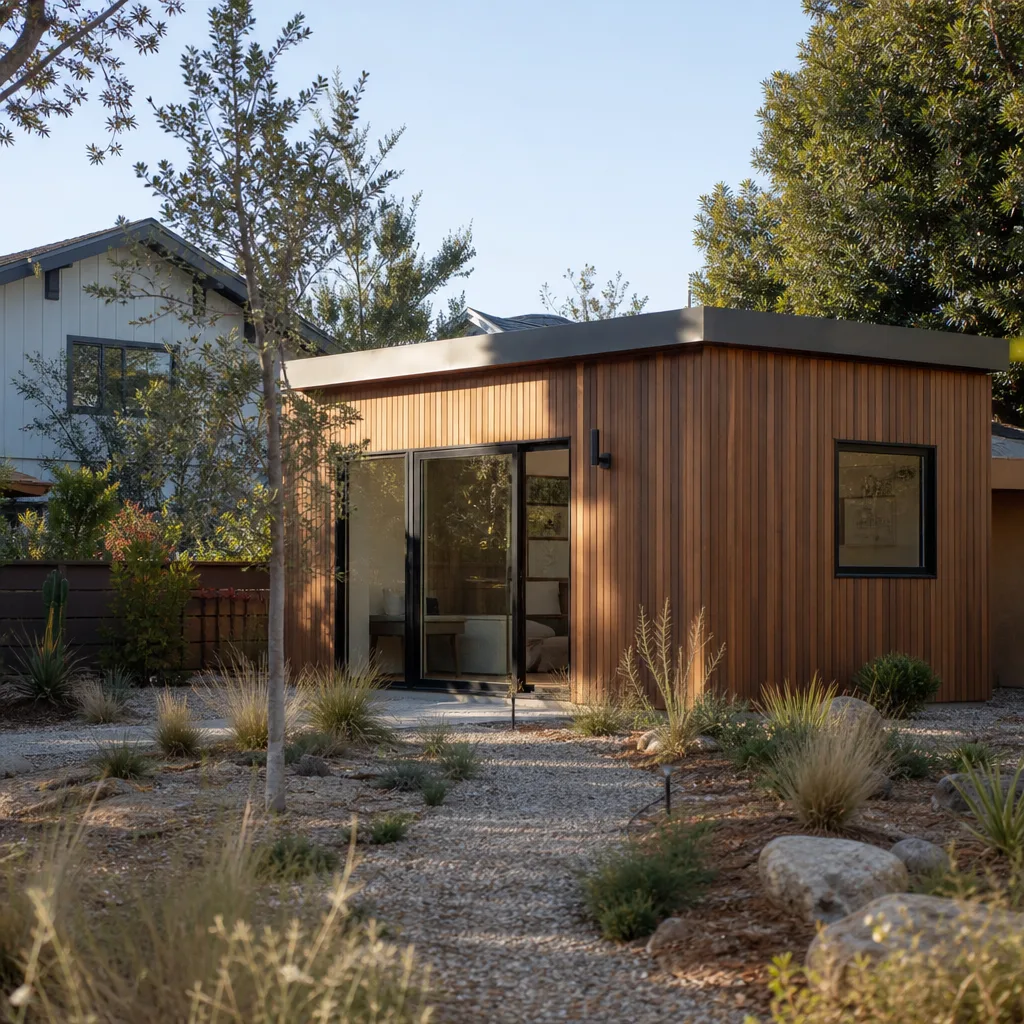
Prefab ADUs are built differently from site-built structures, and their seasonal maintenance reflects that. Panelized systems from brands like Cover, Dvele, and Plant Prefab are manufactured in controlled factory conditions, then assembled on site. That construction method is precise, which is good, but it also means the panels expand and contract slightly with Santa Clarita’s wide temperature swings. Over a full year, the valley’s range from freezing winter mornings to 110°F summer afternoons pushes those panel joints through significant thermal cycling.
The spring and fall are the right times to inspect panel joints on prefab units. Look at the seams where wall panels meet roof panels, where corner panels meet, and where panels join around window and door openings. Small hairline gaps are normal and expected. Gaps wider than 1/8 inch, or gaps that weren’t there the season before, should be sealed before moisture gets in. Most prefab manufacturers use a specific sealant for these joints, and using the wrong product voids the warranty. Check your manufacturer’s maintenance documentation or call the builder who handled the install.
Cover units, which use a steel chassis and panelized construction, have joint details that are particularly sensitive to thermal movement. Dvele units, built around a focus on healthy indoor air, need their ventilation filters checked seasonally too. The manufacturer recommends quarterly filter changes, but in Santa Clarita, summer dust makes monthly checks a better practice during June through September. A Tuff Shed-based studio or backyard office has its own seasonal profile: the wood structure expands and contracts with humidity shifts, and the roof fasteners should be checked in spring before the summer heat causes movement.
The practical takeaway: prefab doesn’t mean maintenance-free. It means the maintenance is different, and it’s usually more predictable if you stick to a schedule. Panel joints don’t rot like old wood framing, but they do move, and ignoring that movement for three seasons turns a $25 sealant fix into a $3,000 wall repair.
What Seasonal ADU Care Costs in Santa Clarita
Most seasonal ADU maintenance costs less than homeowners assume. The expensive problems come from skipping the cheap maintenance. Here’s a realistic range for the tasks covered in this guide, based on current Santa Clarita market rates:
| Task | Frequency | Typical Cost Range |
|---|---|---|
| Mini-split filter cleaning | Monthly (summer) / quarterly | $0 (DIY with water) to $80 (pro service call) |
| Downspout extensions | One-time install, check annually | $12 – $30 per extension (DIY) |
| Vent screen replacement | As needed, check fall | $8 – $25 per screen (materials) |
| Exterior caulking | Annual (fall) | $3 – $12 per tube, $200 – $600 if hired out |
| Cool-roof coating inspection and recoat | Annual inspection, recoat every 3 – 5 years | $1,200 – $3,800 for full recoat |
| Deck staining | Every 2 – 3 years (spring only) | $400 – $1,200 for a typical ADU deck |
| Panel joint inspection on prefab units | Semi-annual (spring and fall) | $150 – $400 per inspection visit |
| Full seasonal inspection by an ADU builder | Annual | $250 – $600 depending on ADU size |
Santa Clarita’s dry climate means some tasks are cheaper here than in coastal cities because materials degrade differently. Caulk lasts longer in low humidity, but Santa Ana winds mean it’s still worth checking every fall. The point is that a full year of proactive seasonal care for a standard one-bedroom ADU in Santa Clarita typically runs $600 to $1,200 total. A single ignored drainage issue costs triple that.
The 12-Month Santa Clarita Maintenance Schedule
If you want one list to follow all year, here it is. Each step is tied to the climate reality of that month in Santa Clarita.
- January: After each significant rain, check downspouts, gutters, and the area around the ADU slab for erosion. Photograph any cracks so you can track whether they grow during the season.
- February: Inspect weep screed and siding bases after the last rain. Clear any soil or debris that has built up against the wall base.
- March: Book your spring roof inspection. Schedule any exterior painting, staining, or sealing work for April or May.
- April: Complete exterior paint, deck stain, and sealant work now, before daytime highs climb past 85°F.
- May: Finish any remaining roof membrane repairs. Check panel joints on prefab ADUs as the weather warms.
- June: Switch mini-split filters to a monthly cleaning schedule. Inspect cool-roof coatings before extreme heat arrives.
- July: Check shade trees for proximity to the roof and walls. Verify that all window screens are intact and exterior caulk isn’t cracking in the heat.
- August: Clean mini-split filters monthly. Test the ADU’s AC performance on the hottest day you can, and note any rooms that run warm.
- September: Complete the defensible space audit before Santa Ana winds peak. Trim branches, clear debris, and check vent screens.
- October: Replace any damaged vent screens. Re-caulk joints that cracked over summer. This is the month the Hillcrest fire taught us not to skip.
- November: Final Santa Ana wind check. Walk the ADU after the first strong wind event and look for loose flashing, shifted panels, or debris accumulation.
- December: Prepare gutters and downspouts for winter rain. Ensure downspouts extend at least 4 feet from the foundation.
Common Mistakes to Avoid
- Painting in summer. Santa Clarita summer heat ruins exterior paint jobs. Paint applied above 90°F fails early. If your painter says they can work in July, find a different painter.
- Skipping fall vent screens because “fire season ended.” October is peak Santa Ana window. The Hillcrest fire wasn’t an anomaly. Check vents in September and October, every year.
- Letting downspouts dump at the slab. This is the single most common issue we see on Santa Clarita ADUs, especially on sloped lots in Canyon Country and Saugus. Fixing it costs $30. Ignoring it costs thousands.
- Cleaning mini-split filters quarterly year-round. Manufacturer intervals don’t account for Santa Clarita’s summer dust load. Go monthly from June through September.
- Using the wrong sealant on prefab panel joints. If your ADU is a Cover, Dvele, or other panelized system, the manufacturer specifies a particular sealant. Using general-purpose caulk may void your warranty. Check the manual.
- Waiting until spring to look at roof damage. The time to find roof issues is after fall winds and winter rain. March is the repair window; December and January are the detection windows.
- Treating all seasons the same. The calendar-based maintenance lists from other regions don’t apply here. Santa Clarita’s climate doesn’t follow the national template, and neither should your ADU care schedule.
When to Call a Professional
Some seasonal ADU maintenance is genuinely DIY-friendly: cleaning filters, clearing debris, checking downspout extensions. But certain issues need a trained contractor. Call a professional if you see panel joints opening wider than 1/8 inch on a prefab ADU, if water ponds on a flat roof for more than 48 hours after rain, if you find mold or moisture inside wall cavities, or if a retaining wall on your sloped Santa Clarita lot shows any crack wider than 1/4 inch. These are structural or water-intrusion signals, and guessing wrong costs far more than the inspection. Benson ADU Santa Clarita offers free estimates in Santa Clarita, and we’ll tell you honestly whether a problem needs immediate attention or can wait a season. Call (661) 219-7906 to schedule a walkthrough.
Frequently Asked Questions
Monthly from June through September, and quarterly the rest of the year. Santa Clarita’s summer dust and 100°F+ heat cycles mean the manufacturer’s quarterly guidance is insufficient during peak cooling season. Call (661) 219-7906 if you’d like a professional seasonal check of your ADU’s HVAC system.
April or May. These are the only Santa Clarita months when daytime temperatures stay reliably below 85°F, which is the maximum for proper paint curing. Painting in summer heat causes premature peeling and uneven adhesion. Schedule your free estimate at (661) 219-7906 before the window closes.
Yes. Santa Clarita sits in a high-fire-risk zone, and Santa Ana winds in September through November make defensible space a safety requirement, not a suggestion. Maintain a 5-foot noncombustible zone around your ADU and keep tree branches at least 10 feet from the structure. A home addition contractor in Santa Clarita can assess whether your existing landscaping meets current fire clearance standards.
Check downspout routing, weep screed drainage, roof ponding, and retaining wall stability. These are the four areas where Santa Clarita’s winter flash rains cause the most damage, especially on sloped lots. If you see water pooling or soil movement, have it looked at before the next storm.
Different, not lower. Prefab systems from brands like Dvele, Cover, and Plant Prefab have panel joints that expand and contract with Santa Clarita’s temperature swings. Inspect those joints twice a year. HVAC filters in prefab units also need the same summer schedule adjustment as site-built ADUs.
Most homeowners spend between $600 and $1,200 per year on proactive seasonal maintenance for a one-bedroom ADU in Santa Clarita. That covers filter cleaning, caulking, inspections, and minor repairs. Major items like roof recoating or deck staining add cost in the years they’re needed. Call (661) 219-7906 for an exact quote on your specific ADU.
The Bottom Line
Santa Clarita’s climate punishes ADUs that get generic, calendar-based maintenance. The heat, the Santa Ana winds, the winter flash rains, and the narrow spring work window each demand their own response. Skipping fall vent screens is dangerous. Painting in summer wastes money. Ignoring downspouts on a sloped lot guarantees foundation problems. The good news is that most seasonal care is inexpensive and quick when done at the right time. The expensive repairs come from doing the right task a season too late. Follow this guide and our more guides & resources, and your ADU will hold up through every season Santa Clarita throws at it.
Contact Benson ADU Santa Clarita
If you’d rather hand the seasonal checklist to someone who does this year-round, we’re here. Our team at Benson ADU Santa Clarita home builds and maintains ADUs across the Santa Clarita Valley, and we’re happy to walk your property and point out what needs attention, what can wait, and what it should cost. No pressure, no obligation. Call (661) 219-7906 to schedule your free estimate.
Written by Troy Eastman, Owner at Benson ADU Santa Clarita, serving Santa Clarita since 2006.