Last updated October 15, 2026
ADU Cost Breakdown: The Santa Clarita Homeowner’s Reference for 2026
That “$150K ADU” you keep seeing in California headlines? It’s a 1,200-square-foot unit on a flat lot in a non-fire-hazard zone with no HOA review. In Santa Clarita, the same unit starts at $215K before a single upgrade. The gap isn’t contractor greed. It’s geography. Hillside lots, fire-zone compliance, longer material haul distances from major suppliers, and city-specific plan-check fees all stack up before the first floor joist is cut. This guide breaks down the real 2026 numbers line by line, so you can walk into any estimate conversation knowing exactly what you’re paying for in Santa Clarita and what should raise a flag-our ADU Warning Signs: A Santa Clarita Homeowner’s Reference Guide covers the red flags in more detail.
Quick Answer
A detached ADU in Santa Clarita in 2026 costs between $240 and $420 per square foot all-in, meaning a 400-square-foot studio runs $96K to $168K, a 600-square-foot one-bedroom runs $144K to $252K, and a 1,000-square-foot two-bedroom runs $240K to $420K. Prefab units from brands like Abodu and Cover land at the lower end of those ranges for the structure itself but often catch homeowners off guard with site work, utility connections, and delivery logistics that standardized quotes don’t always include. The five Santa Clarita-specific cost adders most quotes bury in allowances are hillside grading, fire-zone material upgrades, HOA architectural review fees, hard-water plumbing prep, and city plan-check fees that run higher than county averages.
Table of Contents
- Line-Item Cost Table: Three ADU Types for Santa Clarita, 2026
- The Five Santa Clarita Cost Adders Most Quotes Bury
- Prefab vs. Stick-Built: Real Total Cost at Every Size
- Financing Cost as a Line Item: HELOC vs. Construction-to-Perm
- Where to Save vs. Where Cutting Costs Creates Liability
- The Santa Clarita Permit and Timeline Reality
- Common Mistakes to Avoid
- When to Call a Professional
- Frequently Asked Questions
Line-Item Cost Table: Three ADU Types for Santa Clarita, 2026
These ranges reflect what we’ve seen on actual Santa Clarita projects over the past 18 months, not statewide medians or LA metro averages. Every number assumes a standard rectangular footprint on a lot with reasonable slope (under 10%), existing utility access within 50 feet of the build site, and no HOA design-review complications. We’ll get to what happens when those assumptions break later.
| Line Item | Studio / 400 sq ft | 1BR / 600 sq ft | 2BR / 1,000 sq ft |
|---|---|---|---|
| Design & engineering (architectural, structural, Title 24 energy) | $8,000 – $14,000 | $12,000 – $18,000 | $16,000 – $26,000 |
| City plan check & permit fees (Santa Clarita) | $4,500 – $7,000 | $5,500 – $8,500 | $7,000 – $11,000 |
| Site prep (grading, tree removal, termite treatment, pad) | $9,000 – $22,000 | $12,000 – $28,000 | $16,000 – $38,000 |
| Foundation (slab or raised, seismic & soil report) | $12,000 – $20,000 | $16,000 – $26,000 | $24,000 – $40,000 |
| Structure & framing (stick-built or prefab module set) | $38,000 – $68,000 | $55,000 – $95,000 | $90,000 – $150,000 |
| Mechanical, electrical, plumbing (including panel tie-in) | $18,000 – $32,000 | $24,000 – $42,000 | $36,000 – $60,000 |
| Interior finishes (drywall, flooring, cabinets, fixtures) | $16,000 – $30,000 | $22,000 – $40,000 | $34,000 – $62,000 |
| Fire-zone compliance upgrades (Class A roofing, ember-resistant vents, tempered glazing) | $6,000 – $12,000 | $8,000 – $15,000 | $11,000 – $20,000 |
| Appliance package | $3,000 – $7,000 | $4,500 – $9,000 | $7,000 – $14,000 |
| Utility connections (sewer, water, gas, electric trenching) | $6,000 – $18,000 | $8,000 – $22,000 | $10,000 – $28,000 |
| Landscaping & drainage restoration | $3,000 – $8,000 | $4,000 – $10,000 | $5,000 – $14,000 |
| Contractor overhead & project management (12 – 18%) | $14,000 – $28,000 | $20,000 – $40,000 | $30,000 – $58,000 |
| Total all-in range | $96,000 – $168,000 | $144,000 – $252,000 | $240,000 – $420,000 |
Two things jump out. First, the site work and soft costs (design, permits, prep) often equal 30 to 40 percent of the total budget. Second, the structure itself is rarely the most expensive line item. If a quote only shows you “cost per square foot” without breaking out site work, utility connections, and compliance upgrades, you’re looking at a number that will grow. These are not padded categories. Santa Clarita’s combination of hillside terrain and fire-hazard zones makes them genuine, inspection-stopping costs.
What These Numbers Assume
- Flat or gently sloped lot (under 10% grade). Over 10%, add $20K to $60K+ for retaining walls and engineered grading.
- Existing main panel with at least 100 amps of spare capacity. A new or upgraded panel adds $3,500 to $7,000.
- Utility access within 50 feet. Longer trenching runs add $50 to $150 per linear foot depending on what’s underground.
- No HOA design review. HOAs add both time (30 to 90 days) and fees ($500 to $2,500 just to apply).
- Standard finish level: LVP flooring, quartz counters, mid-grade cabinetry, standard fixtures. Premium finishes add 15 to 30 percent to the interior line.
If you want a deeper look at how Santa Clarita projects compare to nearby markets, our ADU Builders in Santa Clarita page walks through the local process step by step.
The Five Santa Clarita Cost Adders Most Quotes Bury
Here’s the part most guides to ADU in Santa Clarita skip. Santa Clarita isn’t Los Angeles, and a quote built on LA metro assumptions will underestimate your actual cost by 15 to 30 percent. These are the five line items we see omitted or underfunded more than any others on local projects.
1. Hillside Grading and Retaining
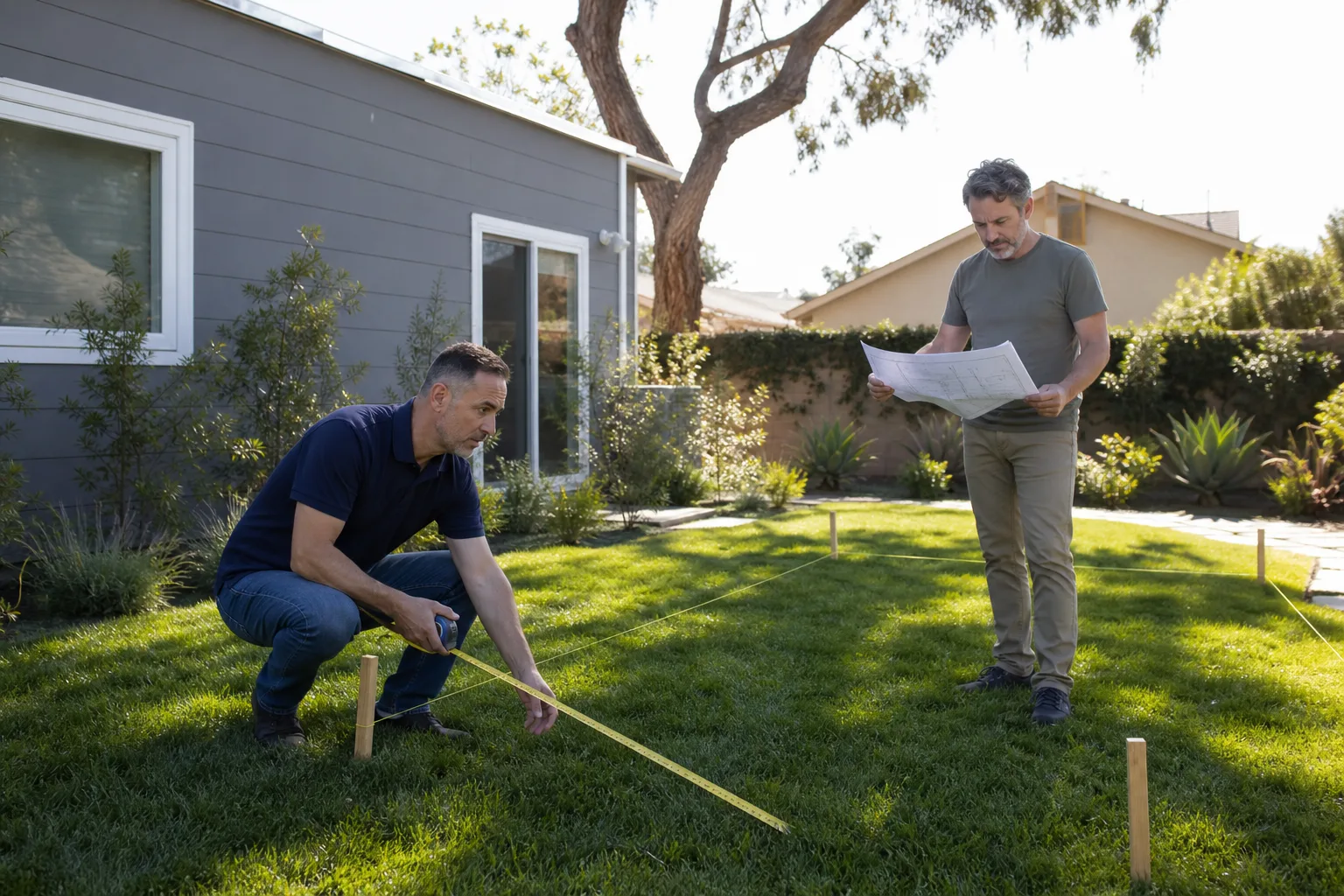
Santa Clarita is a valley ringed by hills, and a significant share of buildable lots carry slope. A 15 percent grade isn’t dramatic to walk on, but it is enough to require a soils report, engineered grading plan, and possibly a retaining wall. We’ve seen grading packages on Canyon Country lots run $35K before a single foundation form is set. Contractors who quote “flat-lot pricing” without visiting the site are guessing. A written price requires a site visit. Always.
2. Fire-Zone Material Upgrades
Much of Santa Clarita sits in Cal Fire’s High or Very High Fire Hazard Severity Zone. That means Class A roofing material, ember-resistant vents, tempered dual-pane glazing, and sometimes non-combustible exterior cladding. These aren’t optional. They’re code. And they add $6K to $20K depending on unit size and specific zone requirements. The upside: these upgrades also lower your insurance premiums and genuinely protect the unit. The downside: a quote that doesn’t reference your specific fire-zone designation hasn’t done its homework.
3. HOA Architectural Review
Valencia, Saugus, and parts of Newhall are heavily HOA-governed. If your community has a design review committee, you’ll need their sign-off before the city will even accept your permit application. Review fees run $500 to $2,500, and the process can add 30 to 90 days. Some HOAs have specific aesthetic standards for exterior materials, roof pitch, and color palettes that overlap awkwardly with fire-zone requirements. You want the plan-check fee, the HOA fee, and the city fee all noted as separate line items. They are separate checks, written to separate entities.
4. Hard-Water Plumbing Prep
Santa Clarita’s water hardness routinely measures 15 to 20 grains per gallon, which is firmly in “very hard” territory. That’s not a problem if you plan for it: a whole-unit water softener or conditioner adds $2,500 to $6,000 and extends the life of your tankless water heater, fixtures, and appliances by years. Skip it, and you’ll be descaling faucets and replacing water heater elements within three to five years. Rental units especially benefit, since tenant turnover means nobody’s maintaining anything.
5. City vs. County Plan-Check Fees
Santa Clarita’s city plan-check and permit fees run meaningfully higher than unincorporated LA County areas because the city maintains its own building department. A 600-square-foot ADU that might cost $3,800 in permits in an unincorporated pocket elsewhere in the county runs $5,500 to $8,500 inside city limits. That’s not a complaint. The city’s reviewers are thorough and the inspection turnaround is generally fast. But it is a real line item that statewide cost guides don’t account for.
Prefab vs. Stick-Built: Real Total Cost at Every Size
Prefab ADUs have become genuinely good products. The build quality from brands like Abodu and Dvele is excellent, the factory-controlled process reduces weather delays, and the speed from foundation to move-in can be half of a traditional build. But the cost conversation around prefab in Santa Clarita needs more honesty than it usually gets.
Where Prefab Quotes Stop
Most prefab quotes you’ll see on a brand’s website cover the module itself: the factory-built box with finishes included. That number is real and often genuinely competitive. An Abodu 500-square-foot one-bedroom module might come in at $150K to $190K delivered. The problem is what’s not in that number: foundation, site grading, utility trenching and connections, permit fees, fire-zone upgrades, delivery logistics (crane or specialized trailer access), and the general contractor who coordinates all of it. Add those back, and the all-in total lands within 5 to 10 percent of a stick-built unit at the same finish level.
The Real Comparison Table
| Size & Type | Prefab All-In Total | Stick-Built All-In Total | Difference |
|---|---|---|---|
| Studio / 400 sq ft | $104,000 – $160,000 | $96,000 – $168,000 | Prefab 5 – 8% higher at low end |
| 1BR / 600 sq ft | $150,000 – $238,000 | $144,000 – $252,000 | Roughly even |
| 2BR / 1,000 sq ft | $235,000 – $390,000 | $240,000 – $420,000 | Prefab 5 – 8% lower at high end |
The honest conclusion: prefab isn’t a way to spend dramatically less. It’s a way to compress the timeline and reduce on-site disruption, which has real value if you’re living in the main house during construction. Brands like Cover and Mighty Buildings offer design customization that traditional framing can match, but rarely beat on schedule. If your priority is speed-to-rental-income, prefab earns its premium. If your priority is the lowest possible total cost, stick-built with a tight scope of work still wins in Santa Clarita.
We build with several of these systems, including Abodu, Cover, and Dvele, and the conversation we insist on having with every homeowner is the same: show me the all-in number with site work included, or don’t show me a number at all. For a broader look at how these decisions play out, see our Home Addition Contractor in Santa Clarita guide.
Financing Cost as a Line Item: HELOC vs. Construction-to-Perm
Nobody’s ADU budget is complete without the cost of the money. A $280K build financed over 10 years looks very different depending on the loan structure. As of early 2026, HELOC rates in California run roughly 7.5 to 9.5 percent variable, while a construction-to-permanent loan (CP) runs 6.5 to 8 percent fixed after the construction phase closes. Here’s the side-by-side on a $280K project with a 20 percent down payment ($56K) and a $224K financed balance.
HELOC (Interest-Only Draw Period, Then 10-Year Repayment)
- Draw period (usually 12 – 18 months during construction): interest only on funds actually drawn. If you draw the full $224K over the build, you’re paying about $1,600 to $1,775 per month in interest during construction.
- Repayment phase: converting to a 10-year amortized repayment at 8.5 percent gives you a monthly payment of roughly $2,780.
- Total interest paid over the life of that 10-year repayment: approximately $109,000.
- Risk: variable rate. If rates rise 1 percent, your payment climbs about $190 per month.
Construction-to-Permanent Loan
- Construction phase (usually 12 months): interest-only on drawn funds at roughly 7 percent, about $1,475 per month when fully drawn.
- Permanent phase: 30-year fixed at 7 percent on the $224K balance gives a monthly payment of about $1,490.
- Total interest over the first 10 years: approximately $140,000 if you stick to the 30-year schedule.
- Advantage: fixed rate, no refinance needed, and you can pay extra principal without penalty to bring total interest down.
The HELOC looks cheaper on paper and often is if rates stay flat and you pay it down aggressively. The CP loan costs more in the long run because it’s amortized over 30 years, but it offers certainty. For most Santa Clarita homeowners we talk to, the deciding factor is simple: can you afford a $2,800 payment if the HELOC rate moves against you? If not, the CP loan’s predictability is worth the extra interest. Your lender, not your contractor, should be the one walking you through these numbers, but you want a contractor who can give you a firm enough construction budget to make this comparison real. A written price before work starts isn’t just about trust. It’s the input your lender needs to structure the loan correctly.
Where to Save vs. Where Cutting Costs Creates Liability
Every homeowners wants to bring the number down. Here’s the honest map of where trimming is smart and where it’s expensive-in-disguise.
Legitimate Ways to Save
- Finish-level discipline. Standard LVP flooring instead of engineered hardwood, mid-grade quartz instead of marble, stock cabinets instead of custom. This can move $15K to $40K off the total. Nothing structural is sacrificed.
- Timing the build outside peak season. Santa Clarita’s rainy season (December through March) slows site work. Contractors hungry for winter work sometimes price 3 to 5 percent lower. The tradeoff: weather delays and a longer schedule.
- Attached ADU instead of detached. Converting existing square footage or building an addition off the main house eliminates an entire foundation, utility trenching run, and often the fire-zone upgrades required for outbuildings. Savings of $30K to $70K are common. For details, see our Room Addition Contractor in Santa Clarita page.
- Simplified roof geometry. A single-ridge gable or shed roof costs 20 to 40 percent less than a hip roof with multiple dormers. Prefab brands like Cover and Abodu use standardized roof profiles for exactly this reason.
- Panel upgrades planned early. If you know you need a main panel upgrade, bundling it into the ADU permit saves a separate permit fee and inspection cycle.
Cuts That Create Future Liability
- Foundation shortcuts. Skimping on soils testing, using lower-grade concrete, or skipping the perimeter drainage plan. Santa Clarita’s expansive clay soils shift with moisture. A foundation that moves creates cracked walls, sticking doors, and eventually structural repair costs three times what the shortcut saved.
- Fire-zone compliance. This is code. It is not optional. An unpermitted fire-compliance shortcut doesn’t just risk fines. It can void your homeowner’s insurance and make the unit unsellable until corrected.
- Permit shortcuts. “We’ll build it and you can permit later.” No. In Santa Clarita, unpermitted ADUs are discovered during resale, refinance, or insurance review. The retrofit cost to bring an unpermitted unit to code often exceeds what the original permit would have cost, and now you’re paying it while the unit sits empty.
- Unlicensed or cash-only labor. No written contract, no license, no warranty, no recourse. The savings evaporate the first time a problem appears and nobody answers the phone.
The Santa Clarita Permit and Timeline Reality
Here’s what a realistic schedule looks like in Santa Clarita in 2026, assuming a straightforward detached ADU on a flat or gently sloped lot with no HOA complications.
- Design and engineering: 4 to 10 weeks. This includes site survey, architectural drawings, structural engineering, and Title 24 energy calculations. Prefab brands compress this because the module design is pre-engineered.
- City plan check and permit issuance: 8 to 16 weeks. Santa Clarita’s building department has improved turnaround notably over the past two years, but fire-zone review adds a layer. HOA review, if applicable, runs parallel or sequentially depending on the HOA’s process.
- Site work and foundation: 2 to 6 weeks. Grading, utility trenching, form-setting, concrete pour, and inspection. Hillside lots add time.
- Construction (stick-built): 3 to 6 months for a 600-square-foot unit. Santa Clarita’s summer heat can slow framing crews, and winter rain pauses concrete and roofing work.
- Module set and finish (prefab): 4 to 10 weeks after foundation cure. The factory builds the module while your site work happens, which is the entire logic of prefab.
- Final inspections and certificate of occupancy: 2 to 4 weeks. Santa Clarita inspectors are thorough, and electrical, plumbing, and fire-safety inspections each need their own pass.
Realistic total: 7 to 14 months from design kickoff to move-in for a stick-built ADU, and 5 to 9 months for prefab. Any contractor promising a fully permitted, inspected, move-in-ready detached ADU in Santa Clarita in under 5 months is describing a project where something got skipped. Usually it’s a permit.
Common Mistakes to Avoid
- Comparing quotes by cost per square foot only. A quote at $310 per square foot that includes site work, utility connections, fire-zone upgrades, and project management may be cheaper all-in than a quote at $270 per square foot that hasn’t accounted for any of it. Compare total scope, not headline rate.
- Not checking the contractor’s experience with Santa Clarita permits. The city’s plan-check process has quirks specific to fire zones, hillside ordinances, and HOA coordination. A builder who’s done 20 ADUs in the San Fernando Valley but none in Santa Clarita will learn on your timeline.
- Ignoring the HOA until demo day. If your Valencia or Saugus community has architectural review, that process needs to start before you even finalize the unit design. An HOA rejection after you’ve paid for engineering is a pure loss.
- Underestimating utility connection distance. The plumber’s trench from the main house to the ADU costs money per linear foot. If your build site is 80 feet from the main sewer line, that’s not a trivial line item, and it’s often buried in “allowances” that get re-priced later.
- Finishing the interior without planning for hard water. Santa Clarita water will destroy cheap fixtures fast. Running a water softener line during rough plumbing costs $800 to $1,500. Retrofitting one after the walls are closed costs $3,000 to $6,000.
- Accepting a verbal estimate as a fixed price. “We’ll figure out the details as we go” is a scope-change machine. The written price before work starts is the single best protection a homeowner has. If a contractor won’t put it in writing, that tells you what you need to know.
- Delaying the insurance conversation. Adding an ADU changes your homeowner’s policy during construction and after. Notify your insurer before breaking ground, and ask specifically about fire-zone coverage.
When to Call a Professional
If your lot has any slope beyond a gentle grade, if you’re in a fire-hazard zone (which covers much of Santa Clarita), if you have an HOA, or if your utility connections run long distances from the main house, you want a builder who’s done this in Santa Clarita before. These are not edge cases here. They’re the default. A professional site evaluation takes about an hour and tells you more about your real budget than any online calculator. Benson ADU Santa Clarita home offers free estimates in Santa Clarita, and every estimate includes a written, line-itemed price before any commitment. Call (661) 219-7906 to schedule yours.
One more trigger: if you’ve received two quotes that are more than 20 percent apart, don’t pick the cheaper one on principle. Get a third set of eyes on the scope. In our experience, when quotes diverge that much in Santa Clarita, one of them is usually missing a line item. Finding out which one before you sign is the cheapest money you’ll ever spend.
Frequently Asked Questions
An ADU in Santa Clarita in 2026 costs between $240 and $420 per square foot all-in, meaning a 400-square-foot studio runs $96K to $168K, a 600-square-foot one-bedroom runs $144K to $252K, and a 1,000-square-foot two-bedroom runs $240K to $420K. These ranges include design, permits, site work, construction, finishes, and utility connections, and they assume a flat or gently sloped lot. Hillside lots and fire-zone upgrades push costs higher. Call (661) 219-7906 for a free estimate with a written, line-itemed breakdown.
Santa Clarita ADU costs run higher than LA metro averages because of five local cost drivers: hillside grading requirements on many lots, Cal Fire high-hazard zone material upgrades like Class A roofing and ember-resistant vents, HOA architectural review processes in communities like Valencia and Saugus, hard-water plumbing preparation, and city plan-check fees that exceed county rates. None of these are optional, and all of them add real cost before construction begins.
A prefab ADU is not meaningfully cheaper than a stick-built ADU in Santa Clarita once all costs are included. The module itself from brands like Abodu or Cover carries a competitive price, but foundation, site work, utility connections, permits, fire-zone compliance, and delivery logistics add 30 to 40 percent back to the total. Prefab’s real advantage is timeline compression: 5 to 9 months versus 7 to 14 months for stick-built. Call (661) 219-7906 to discuss which approach fits your budget and schedule.
With a written price before work starts, the price should not change unless you change the scope. Change orders happen when a homeowner upgrades finishes, adds square footage, or a site condition appears that wasn’t visible during the initial evaluation. The protection against surprise pricing is a detailed, line-itemed written estimate that names specific allowances for site work and utility connections rather than broad categories that can be re-priced later. Every Benson ADU project starts with that written price.
Yes, every ADU in Santa Clarita requires a city building permit, and most require additional review from the HOA if your community has one. Building without a permit creates problems at resale, refinance, and insurance review, and the cost to retrofit an unpermitted unit to code usually exceeds what the original permit would have cost. A licensed contractor will never suggest skipping permits.
A stick-built ADU in Santa Clarita takes 7 to 14 months from design kickoff to move-in, while a prefab ADU takes 5 to 9 months. The timeline is driven by design and engineering (4 to 10 weeks), city plan check (8 to 16 weeks), site work and foundation (2 to 6 weeks), construction (3 to 6 months for stick-built or 4 to 10 weeks for prefab), and final inspections (2 to 4 weeks). HOA review can add 30 to 90 days.
The Bottom Line
Santa Clarita ADU costs in 2026 are higher than the headlines suggest, but for specific, identifiable reasons. Hillside grading, fire-zone compliance, HOA review, hard water, and city plan-check fees are not optional line items. They’re the reality of building in this valley, and a quote that ignores them isn’t a bargain. It’s incomplete. The homeowners who get the best outcome are the ones who demand a written, line-itemed price before work starts, understand what’s actually included, and compare total scope rather than cost per square foot. A $96K studio or a $420K two-bedroom are both realistic outcomes depending on your lot, your finishes, and your builder’s thoroughness. Know which one you’re actually paying for before you sign, and explore our more guides & resources to keep planning.
Written by Troy Eastman, Owner at Benson ADU Santa Clarita, serving Santa Clarita since 2006.